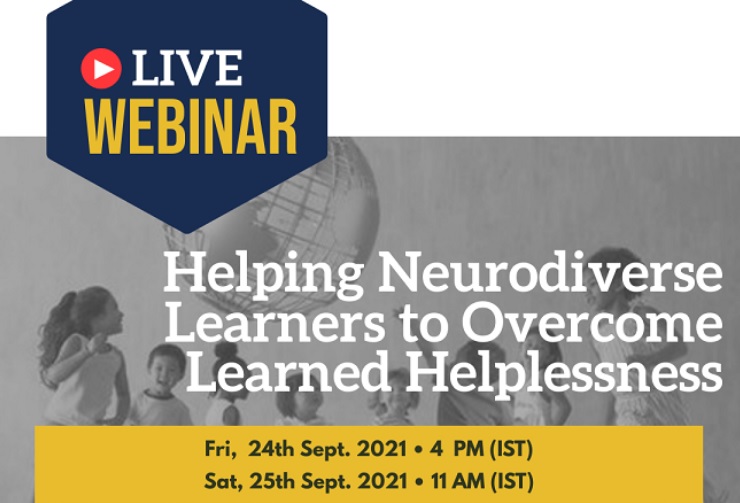
Or how a child can overcome learned helplessness — September 24 and 25. The training is intended for specialists in education and school psychology and is conducted in English.
Over the past year and a half, the pandemic has challenged psychologists and mental-health specialists with new opportunities for community contact. Many trainings happened online for the first time, and while at first this raised concerns and discomfort, today it seems to have become the norm. Online sessions, alongside the technical hiccups that sometimes accompany them, also bring unexpected new ideas.
Today, attending a lecture being held in India, for instance, depends only on whether you have a computer or phone with internet, and whether you happen to be free on Friday at noon and early Saturday morning.
Those time slots are when the Neurodiversity training will take place — September 24 at 12:30 PM Bulgarian time and September 25 at 7:30 AM Bulgarian time. According to the organizers, the term Neurodiversity describes the different ways in which the brain functions in each individual.
Every student has a different set of interests, strengths, and goals, regardless of age, ability, or subject. A child struggling with academic ambitions may also suffer from a sense of learned helplessness. Poor performance at school can make people feel that nothing they do is right or useful. In this way, children sometimes lose the motivation to try to develop in different areas of life.
In the online session organized by the Indian education program Energia Soi, you'll learn how "different" children can be helped to overcome their feelings of learned helplessness.